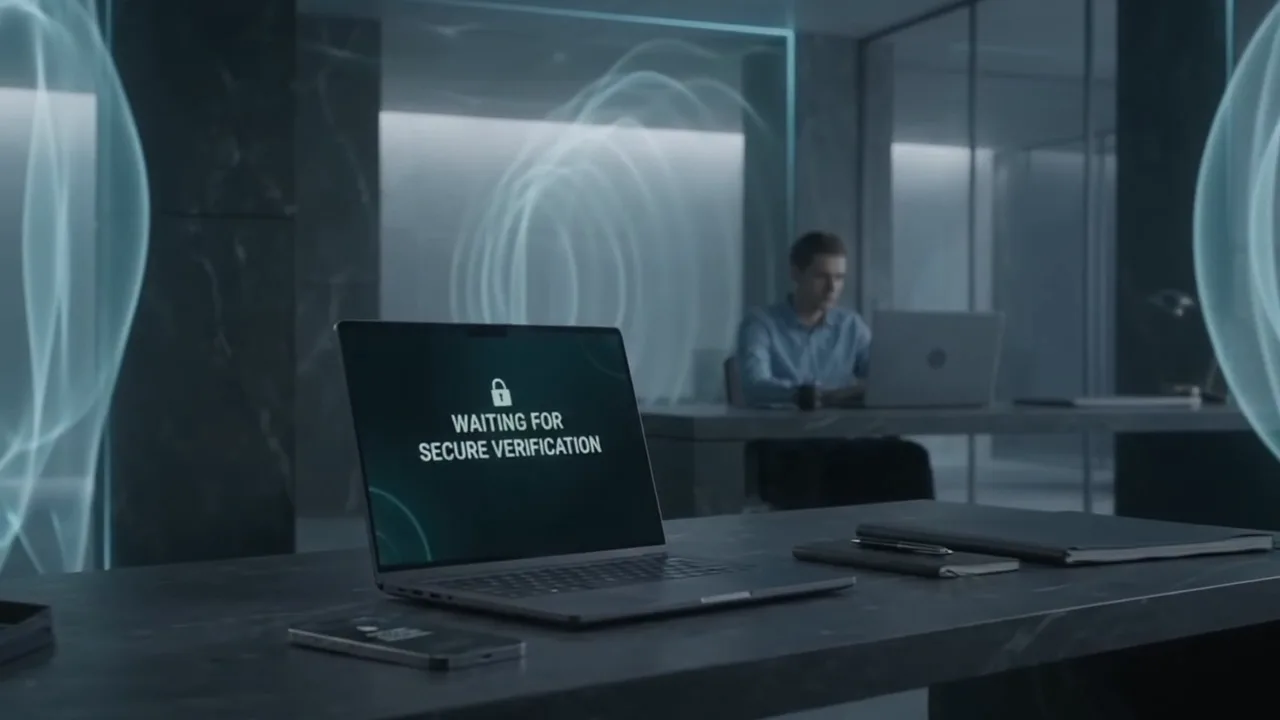

Let the physical world be the key.
A password works anywhere — which is why it can be stolen anywhere. KeyPulse only works here, and only now.
Ask KeyPulse
What do you want to know about KeyPulse?
What is KeyPulse?
KeyPulse proves that two expected devices were physically together at the exact moment a sensitive operation was authorized.
One device emits a brief physical probe into the space around it. Both devices independently record how that space responds. Two devices close together record compatible observations; a device somewhere else cannot.
When the two observations match, that match becomes a one-time proof — created then and there, never stored, never reusable. A new primitive, complementary to passwords and passkeys.
Patent 0514BR002FR · KeyPulse concept note The technology →
What is KeyPulse Secure Chain?
KeyPulse Secure Chain is one implementation: a phone, a wearable, and one sensitive authorization.
You reach a sensitive site and enter only a name. A one-time challenge arrives on the phone. You approve it on the wearable. The physical event runs between the two devices; when their observations match, the operation is authorized — APPROVED. It can also be REJECTED. KeyPulse informs the decision; it is not the decision.
A working end-to-end prototype exists on real hardware — an ESP32-C3 card, an Android app, a backend — with real cryptography. A prototype / R&D demonstrator.
KeyPulse Secure Chain — architecture note KeyPulse Secure Chain →
How is it different from a passkey?
A passkey proves one authenticator. Secure Chain adds a property no single-device authenticator has: fresh physical co-presence of two independent devices.
FIDO2 and passkeys are excellent at proving possession of a key and a local user check. Secure Chain keeps all of that and adds one thing — a proof that the two devices were in the same place at the instant of the operation.
It is a layer you add where a physical proof is worth it — a high-value transfer, a change of admin rights, an irreversible action — not a replacement for the login you already have.
KeyPulse — authentication comparison note Security posture →
What does the room have to do with it?
The specificity comes from the place. A physical event interacts with the walls, the objects and the exact geometry of one room at one instant — and that interaction is what the two devices share.
Because the observation is tied to a real environment and a real moment, it is not something an attacker can hold in advance or reproduce from somewhere else.
The environment is not set dressing — it is where the freshness and the uniqueness of the proof come from. Entropy from the physical world, turned into security.
Patent 0514BR002FR KeyPulse Research →
How does the observation actually work?
At concept level: a probe goes out, the space responds, both devices sample that response, and the two samples are compared.
The principle does not depend on a single signal type — radio, Bluetooth, acoustic and optical are all in scope. The public description stays at the level the patent has already published.
What matters to understand it: two independent samples of the same physical moment, and a comparison that only succeeds when the devices were genuinely together.
Patent 0514BR002FR §71–72, §105–107
What does “PRESENT” really prove?
PRESENT means the device’s own local user-verification approved the use of its key for this operation — not that a named person is there or acting freely.
The four properties Secure Chain establishes: WHO (the account), PRESENT (a local user check happened), TOGETHER (two devices produced compatible observations of one event), NOW (created at the moment, and did not exist before).
Being precise about what each one does and does not prove is deliberate. KeyPulse is built to be reasoned about honestly.
Secure Chain architecture §6 · Threat model §2 Security posture →
Can it be relayed or replayed?
Replay of a recording of a past ceremony is addressed and validated on real hardware. A real-time physical relay is a harder, open problem — and we say so.
Each ceremony is bound to a fresh challenge tied to that one operation, so a recording of a previous session does not work again.
A live relay between two places at the same instant is harder to reason about. KeyPulse is designed to raise the cost and change the nature of that attack; it does not claim to make it impossible.
KeyPulse — known-limitations note Security posture →
Is this only for phones and watches?
The phone and wearable are one way to use KeyPulse. The principle could apply wherever two devices must prove they are physically together.
Access and identity, a vehicle cabin, headless IoT pairing, industrial and critical-infrastructure settings — the same idea. Those directions are exploratory; the phone-and-wearable Secure Chain is the one built end to end.
KeyPulse is not a smartwatch feature and not a phone feature. It is the underlying physical-security technology.
Application taxonomy The technology →